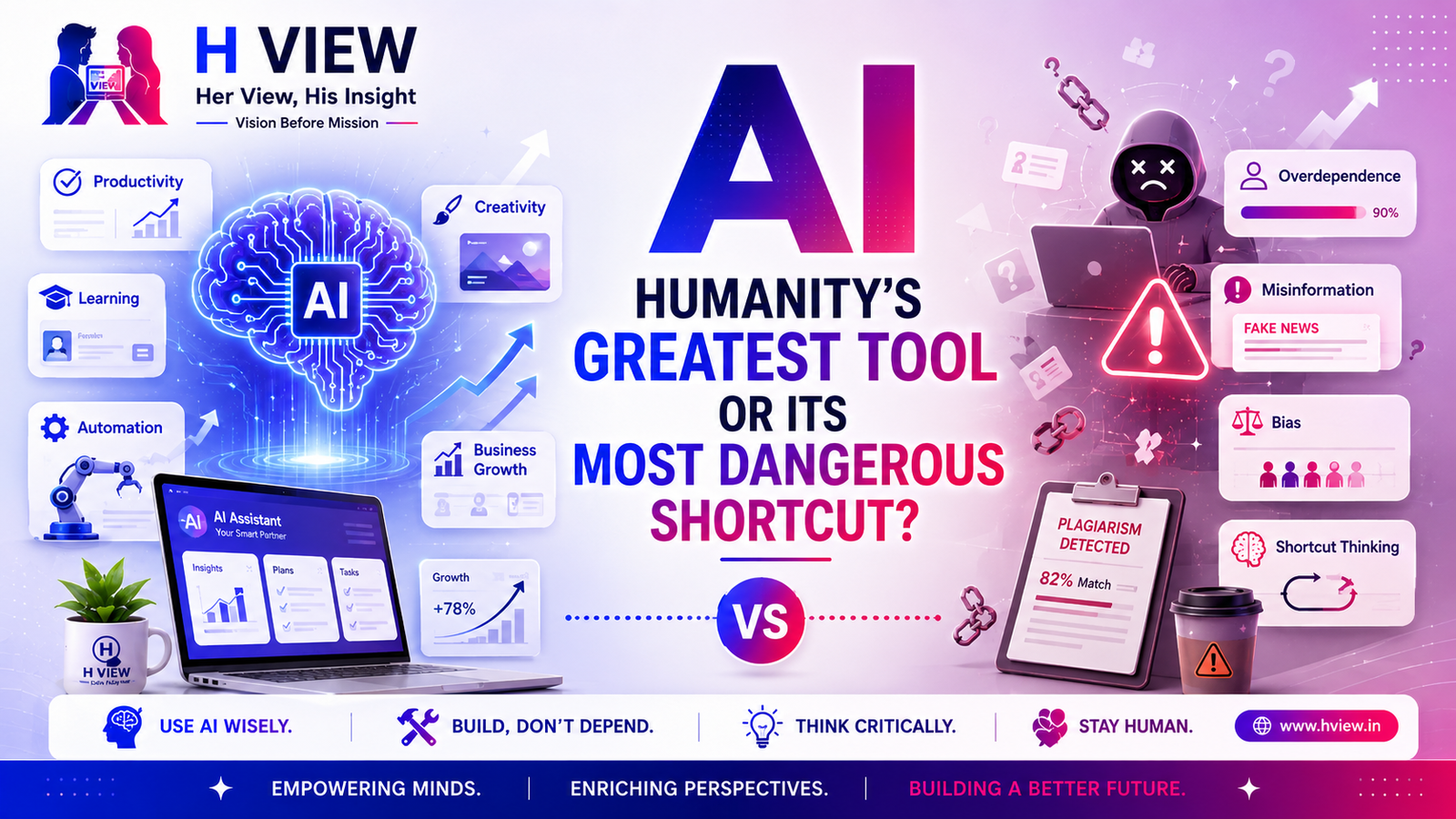
Artificial intelligence can make useful knowledge easier to reach. A student can ask for another explanation, a developer can inspect an unfamiliar error, and a small business can draft a first version of a customer email. The same convenience raises a harder question: when does assistance help us think, and when does it quietly replace the thinking we meant to do?
The answer is not that AI is either a miracle or a threat. It depends on the task, the user’s skill, the quality of the tool, and whether a person checks the result. This article looks at that trade-off and offers a practical way to use AI while keeping human judgment in the loop.
What AI does well—and what it cannot promise
Generative AI can produce a plausible explanation, outline, translation, code suggestion or summary from a prompt. That can lower the effort needed to begin a task. It does not guarantee that the answer is true, complete, current, original or suitable for a particular person. A fluent response is still a response that needs checking.
For routine work, the time saved may be real: asking for alternative phrasings, turning notes into a draft, or generating test cases can help a person move faster. Our guide to how AI can speed up software development without making it instant looks at why human review, testing and context still matter.
The useful question is therefore not “Can AI do this?” but “Which parts can I safely delegate, and what must I personally verify?” That distinction matters in schoolwork, hiring, health, finance, legal matters and any situation where a wrong answer can affect someone’s options.
The risk is unearned confidence
AI systems can make mistakes that sound polished. They may mix up facts, invent a citation, miss a local rule or flatten a disagreement into a single confident answer. Users can also provide incomplete or misleading prompts and receive a response that fits those limits without making them obvious.
That is why AI output should be treated as a draft or lead, not as automatic evidence. Check important facts against the original document or a reliable source. Open cited links instead of assuming they exist. For changing details such as prices, eligibility, dates or product specifications, verify the current primary source. Avoid entering private, confidential or sensitive information unless you understand the service’s data controls and your organisation permits it.
UNESCO’s guidance on generative AI in education and research frames the issue around human agency, inclusion and appropriate safeguards. It is policy guidance rather than proof that AI harms learning; it is useful because it asks educators and institutions to design for people’s needs instead of treating the tool as a substitute for them.
Does using AI weaken critical thinking? The evidence is still developing
It is reasonable to worry that habitual outsourcing could reduce practice in reading, recalling, comparing or explaining ideas. But a concern is not the same as a settled conclusion. Effects can differ by age, task, experience and how a tool is used. A student who asks AI to reveal every answer has a different learning experience from one who tries first, asks for hints and then checks the explanation.
A 2025 MIT Media Lab preprint studied essay writing under different conditions. Its abstract reports 54 participants in the first three sessions, with 18 taking part in a fourth session; it measured EEG activity and assessed essays and recall. The authors reported differences between the groups and called for deeper research. This is a small, task-specific preprint, not a final verdict about everyone’s brain or every use of AI. It cannot establish that ordinary AI use causes lasting cognitive decline. Read the study summary and its stated methods before drawing broader conclusions.
That limitation should make the conversation more careful, not less useful. The study gives a reason to test learning practices and ask what people retain. It does not justify claims that AI inevitably makes users less intelligent.
A practical routine that keeps the user in charge
A balanced workflow keeps the difficult or consequential judgment with the person doing the task. Try this sequence:
- Attempt first. Write your own outline, solution or interpretation before asking AI, especially when the goal is to learn.
- Ask for support, not a finished answer. Request a hint, counterargument, explanation at another level, or list of questions to investigate.
- Verify key claims. Check numbers, quotations, citations, code and current details against original or authoritative sources.
- Explain the result in your own words. If you cannot explain why it is sound, keep investigating instead of submitting or acting on it.
- Protect people and data. Remove personal information and follow the rules of your school, workplace or client agreement.
- Keep a human decision-maker. Do not let an unreviewed model decide a high-stakes outcome about a person.
For creators and small teams, tool choice also matters: our overview of AI tools for bloggers and content creators is a starting point for comparing use cases. If you are thinking about how AI-generated answers affect online discovery, see our guide to AI search and visibility. These guides discuss workflows and trade-offs; they are not endorsements of every tool or a claim that one product is best for every reader.
Her View: access should widen participation
AI can make a first explanation or draft easier to obtain for people who lack a tutor, specialist colleague or large budget. That potential matters. But access is meaningful only when people can judge what they receive. Clear explanations, language support and transparent limits should help users build capability, not leave them dependent on answers they cannot assess.
His Insight: convenience needs a boundary
A fast answer is valuable when it removes repetitive work. It becomes risky when speed is mistaken for understanding. The sensible boundary is to delegate tasks that are easy to check and keep responsibility for interpretation, evidence and decisions. That boundary will change with the person and the task; it cannot be set by a product label alone.
H View perspective
AI can be a powerful assistant and still be wrong. The best safeguard is an active user: someone who frames the task, checks sources, notices uncertainty and takes responsibility for the final choice. Whether AI expands learning or replaces practice depends in part on the habits people and institutions build around it.
For a related look at changing information habits, read our comparison of ChatGPT and Google Search. The broader point is simple: use AI to widen the questions you can ask, then do the work needed to decide which answers deserve trust.