In a world where our smartphones are practically attached to our hands—or resting against our legs in our pockets—it is natural to wonder what all that unseen wireless energy is doing to us. Every time your device sends a message, stream a video, or connects to a cellular tower, it emits Radiofrequency (RF) energy.
To regulate this energy and protect consumers, scientists and standard organizations created a metric called the Specific Absorption Rate (SAR). But what does SAR actually mean for your day-to-day health, and should you be worried?
What Exactly Is SAR Value?
SAR stands for Specific Absorption Rate. Simply put, it measures the rate at which your body absorbs radiofrequency (RF) electromagnetic energy emitted by a electronic device like a smartphone.
- Units of Measurement: SAR is expressed in Watts per kilogram (W/kg).
- How It Is Calculated: Testing is conducted using a fluid-filled head or body model designed to simulate human tissue. A phone is placed against this model while transmitting at its highest power level.
- Regulatory Limits:
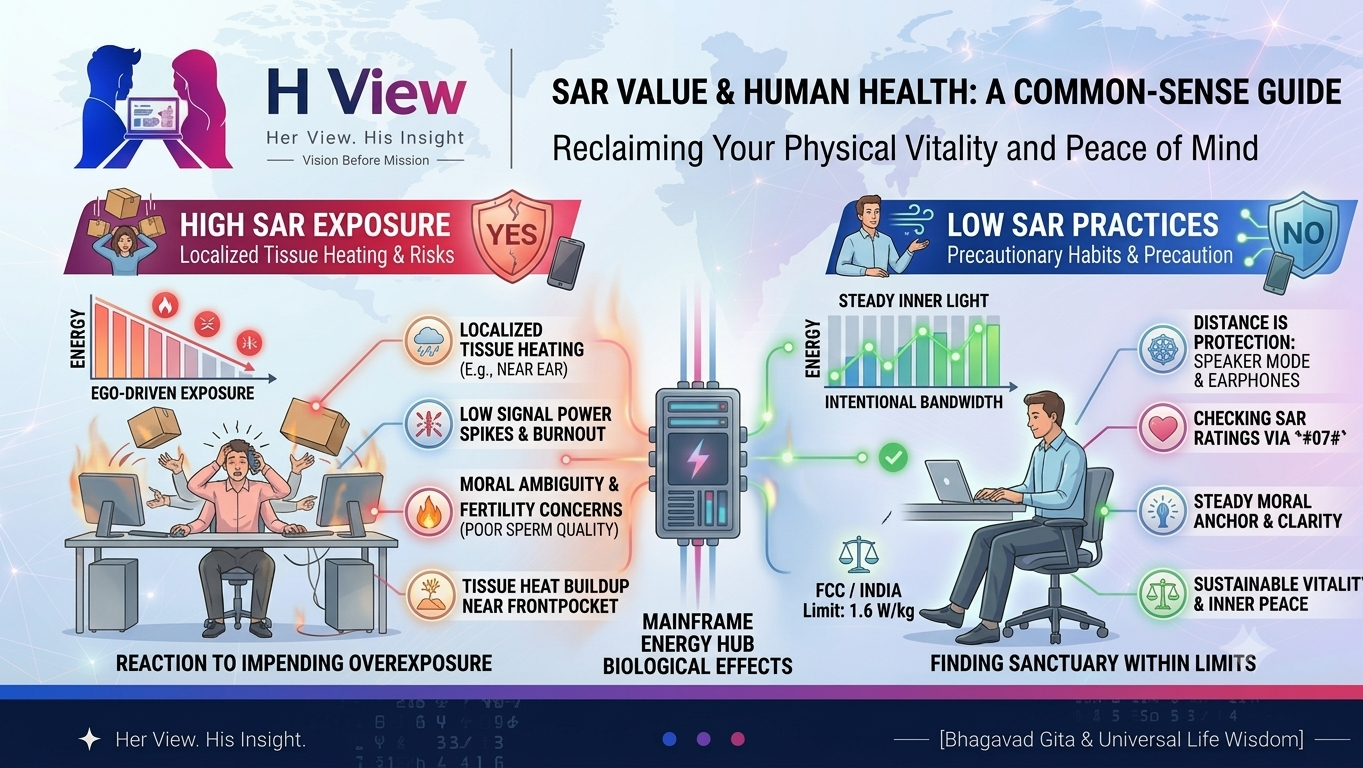
- India & USA (FCC): The maximum allowed SAR limit is 1.6 W/kg averaged over 1 gram of actual tissue.
- Europe (ICNIRP): The limit is 2.0 W/kg averaged over 10 grams of tissue.
If a phone passes these thresholds, regulatory bodies deem it safe for consumer use.
How Does RF Radiation Interact with the Human Body?
To understand SAR, it helps to distinguish between two main types of radiation: Ionizing and Non-Ionizing.
- Ionizing Radiation (X-rays, Gamma Rays): High-frequency energy capable of stripping electrons from atoms, breaking chemical bonds, and directly damaging DNA.
- Non-Ionizing Radiation (RF, Wi-Fi, Microwaves): Lower-frequency energy. It lacks the power to strip electrons or break DNA bonds directly.
Smartphones emit non-ionizing RF energy. The primary known biological effect of non-ionizing RF energy on human tissue is thermal heating—essentially, a micro-scale version of how a microwave warms food, though at vastly lower power levels.
Biological Impacts: What Does the Science Say?
While the thermal effects of RF energy are well-established, researchers continue to study potential non-thermal effects from prolonged exposure.
- Tissue Heating: When you hold a phone to your ear for an extended period, the tissue near the ear absorbs RF energy, resulting in a tiny, temporary rise in local temperature (usually fractions of a degree).
- Neurological & Sleep Patterns: Some studies suggest that heavy evening phone use near the head might subtly alter brain activity during sleep, though it remains unclear whether this is caused by RF energy, blue light, or mental stimulation.
- Fertility Concerns: Storing high-transmitting devices continuously in front pockets close to sensitive areas has raised concerns regarding sperm quality and motility due to localized heat buildup.
- Long-Term Cancer Risk: The World Health Organization's International Agency for Research on Cancer (IARC) classifies RF electromagnetic fields as Group 2B: "Possibly Carcinogenic to Humans." This classification means there is limited evidence of risk, requiring ongoing long-term research, but no definitive causal link has been proven.
Smart Habits to Minimize RF Exposure
You do not need to throw away your smartphone to stay safe. Because RF energy drops off dramatically with distance (following the inverse-square law), minor habit adjustments significantly lower your actual exposure:
- Use Speaker Mode or Earphones: Keeping the phone even a few inches away from your head drastically cuts down local absorption.
- Avoid Low-Signal Calling: When your phone has low signal bars, it automatically boosts its transmitter power to reach the tower, increasing emissions.
- Keep Devices Away from Your Bed: Avoid sleeping with your phone right under your pillow or next to your head while it is active or charging.
- Text or Stream Over Wi-Fi: Texting keeps the device away from your head, and stable Wi-Fi connections often require less transmission power than weak cellular networks.