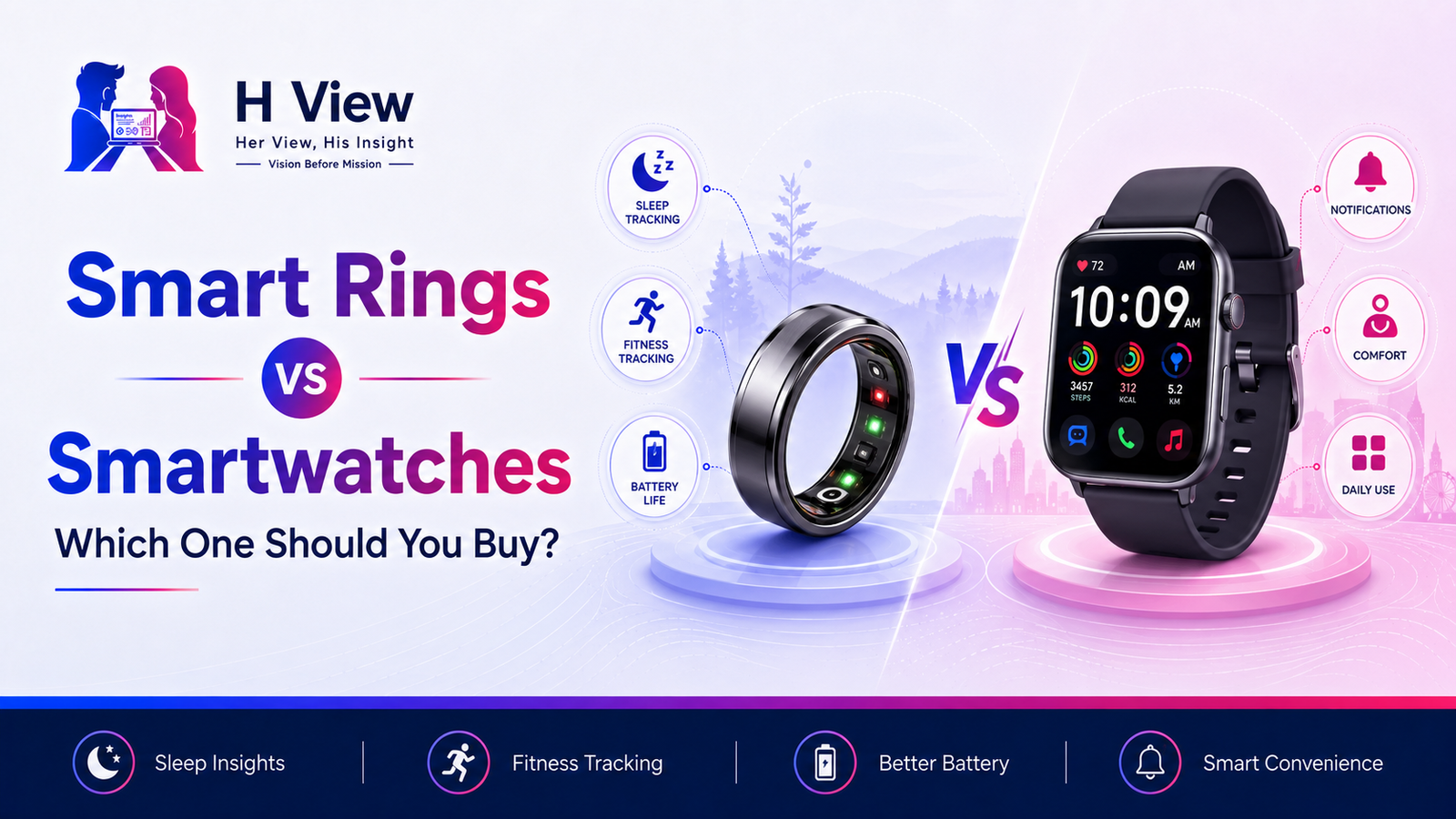
Wearable tech is no longer only about counting steps.
Today, people use wearables to track sleep, heart rate, workouts, stress, recovery, notifications, calls, payments and daily activity. But the choice is no longer limited to smartwatches. Smart rings are now becoming serious competitors.
A smartwatch sits on your wrist and works almost like a mini phone. A smart ring sits on your finger and quietly tracks health and recovery in the background.
Both sound useful, but they are not made for the same type of user.
At H View, our practical view is simple:
Buy a wearable based on what you will actually wear every day, not based on what looks most advanced.
What Is a Smart Ring?
A smart ring is a small wearable device worn on the finger. It usually tracks health and activity data without a screen.
Most smart rings focus on:
- Sleep tracking
- Heart rate
- Heart rate variability
- Skin temperature
- Readiness or recovery score
- Stress insights
- Activity tracking
- Period prediction or cycle insights in some models
- Basic wellness trends
Smart rings are designed to be silent, light and less distracting. The idea is to collect health data without constantly pulling your attention.
Research also supports why rings are interesting for health tracking. Fingers have many blood vessels and are naturally suited for continuous biometric sensing, making smart rings useful for passive health monitoring and all-day wear.
What Is a Smartwatch?
A smartwatch is a wearable device worn on the wrist with a screen.
It usually does much more than health tracking.
A smartwatch can offer:
- Time and notifications
- Calls and messages
- Fitness tracking
- Heart rate monitoring
- Workout modes
- GPS
- Music control
- Payments
- Apps
- Voice assistant
- Fall detection in some models
- Emergency features in some models
A smartwatch is more interactive. You look at it, tap it, respond from it and use it throughout the day.
That makes it more powerful, but also more distracting.
Design and Comfort
This is where smart rings feel very different from smartwatches.
A smart ring is small and subtle. You can wear it while sleeping, working, travelling or attending meetings without it looking like a gadget. For people who do not like wearing watches, a ring can feel more natural.
But comfort depends heavily on size. If the ring is too tight, it feels irritating. If it is loose, the sensors may not work properly. Smart rings also need proper sizing before purchase.
A smartwatch is more visible. Some people love the look. Some feel it is bulky, especially while sleeping. If you already wear a traditional watch, switching to a smartwatch may feel normal. If you dislike wrist wear, it may feel uncomfortable.
Health Tracking
Smart rings are especially strong for passive health tracking.
They are good at tracking sleep, recovery, resting heart rate, temperature changes and long-term wellness patterns. Devices like the Oura Ring 4 are designed around sleep and recovery, with Oura listing a battery life of 5–8 days depending on usage. Samsung’s Galaxy Ring also focuses on all-day health tracking, with Samsung listing up to 7 days of battery life on certain sizes and 3 built-in sensors for health monitoring.
Smartwatches are stronger for active health and fitness use.
They are better when you want to start workouts, see live metrics, track GPS routes, check pace, view heart rate zones and receive alerts during exercise.
So the simple difference is:
Smart rings are better for quiet health tracking. Smartwatches are better for active fitness tracking.
Fitness Tracking
If you run, cycle, swim, lift weights or track workouts seriously, a smartwatch is usually more useful.
The reason is simple: it has a screen.
During a workout, you can see:
- Heart rate
- Calories
- Pace
- Distance
- Workout time
- GPS route
- Training zones
- Notifications
- Music controls
A smart ring can track activity, but it is not as interactive during workouts. You usually check the data later in the app.
For casual fitness and recovery, smart rings are good. For serious workouts, smartwatches are better.
Sleep Tracking
Smart rings have a strong advantage for sleep tracking because they are easier to wear at night.
Many people remove their smartwatch before sleeping because it feels bulky or needs charging. A ring is usually lighter and less noticeable.
Smart rings also focus heavily on sleep quality, readiness and recovery. This makes them useful for people who want to understand sleep patterns rather than only count steps.
Smartwatches can also track sleep well, but comfort and battery become the main issues. If your smartwatch needs charging at night, sleep tracking becomes difficult.
Battery Life
Battery life is one of the biggest differences.
Smart rings usually last several days because they do not have large displays. Oura lists 5–8 days for the Oura Ring 4, while Samsung says the Galaxy Ring can last up to 7 days depending on size and usage.
Smartwatches usually need more frequent charging because they have screens, apps, notifications, GPS and more active features. Apple’s latest Watch Series 11 technical specs list up to 24 hours of normal use and up to 38 hours in Low Power Mode.
For people who hate charging devices often, smart rings have a clear advantage.
Notifications and Daily Use
Smartwatches are much better for notifications.
You can see calls, messages, app alerts, calendar reminders and even reply to some notifications. This is helpful if you want quick access without taking out your phone.
But it can also become distracting.
A smart ring usually does not show notifications because it has no display. That may sound like a weakness, but for many users it is actually a benefit.
If you want less screen time, a smart ring is peaceful.
If you want quick alerts, a smartwatch is practical.
Style and Everyday Wear
Smart rings look more like accessories. They blend with daily outfits and do not immediately look like tech gadgets.
This makes them attractive for people who want health tracking without wearing a screen on their wrist.
Smartwatches are more visible. They can look stylish, sporty or premium depending on the model and strap, but they still look like gadgets.
If fashion and minimalism matter, smart rings feel cleaner. If utility matters more, smartwatches win.
Price and Value
Smart rings can feel expensive because they do fewer things than smartwatches.
You may pay a premium for a small device that mainly tracks health and wellness. Some smart rings may also have subscription costs for full insights, depending on the brand.
Smartwatches give more features for the price. Even mid-range smartwatches can offer display, calls, notifications, workouts, GPS and apps.
But value depends on usage.
If you only care about sleep and recovery, a smartwatch with 100 features may not be necessary. If you want one device for health, notifications, workouts and daily use, a smartwatch gives better all-round value.
Smart Ring Pros and Cons
Pros
- Comfortable for sleep tracking
- Subtle and stylish
- Longer battery life
- Less distracting
- Good for recovery and wellness insights
- Easy to wear all day
- Better for people who dislike watches
Cons
- No display
- Limited workout interaction
- Sizing must be correct
- Can be expensive for fewer features
- Some models may need subscriptions
- Not ideal for calls or notifications
- Less useful for serious fitness tracking
Smartwatch Pros and Cons
Pros
- Useful screen
- Better for workouts
- Notifications and calls
- GPS and apps
- More interactive features
- Good all-round wearable
- Better for fitness-focused users
Cons
- Needs more frequent charging
- Can feel bulky during sleep
- More distracting
- Battery life varies by model
- Some models are expensive
- May not suit people who dislike wrist wear
Who Should Buy a Smart Ring?
A smart ring is better if you:
- Want better sleep tracking
- Prefer a subtle wearable
- Do not want constant notifications
- Care about recovery and wellness
- Want longer battery life
- Do not like wearing watches
- Want health tracking without a screen
- Prefer a minimal lifestyle gadget
Smart rings are best for people who want quiet, background health insights.
Who Should Buy a Smartwatch?
A smartwatch is better if you:
- Want workout tracking
- Need notifications on your wrist
- Want calls, apps and quick controls
- Need GPS for running or cycling
- Like seeing live fitness data
- Want one all-round wearable
- Prefer a screen-based experience
- Want more features for the price
Smartwatches are best for people who want an active, interactive wearable.
Common Buying Mistakes
Many people buy wearables because they look trendy.
Avoid these mistakes:
- Buying a smart ring without checking size properly
- Buying a smartwatch only for health tracking when you hate wearing watches
- Ignoring battery life
- Ignoring subscription costs
- Buying for features you will never use
- Not checking phone compatibility
- Expecting medical-level accuracy
- Wearing the device inconsistently and expecting perfect insights
A wearable only works when you actually wear it regularly.
H View Recommendation
For most people, the choice is simple.
Choose a smart ring if you want comfort, sleep tracking, recovery insights and fewer distractions.
Choose a smartwatch if you want fitness tracking, notifications, GPS, apps and more daily interaction.
At H View, our recommendation is:
Smart ring for quiet health tracking. Smartwatch for active daily control.
Smart rings are better for sleep, comfort, battery life and passive health tracking. Smartwatches are better for fitness, notifications, GPS, calls and apps.
Not fully. A smart ring can replace a smartwatch for health and sleep tracking, but not for screen-based features like notifications, calls, apps and live workout data.
Smart rings can provide useful wellness trends, but they should not be treated as medical devices unless specifically certified for a medical function.
Smart rings are usually better for sleep tracking because they are more comfortable to wear overnight and have longer battery life.
Smartwatches are better for workouts because they show live data, support GPS, offer workout modes and provide real-time feedback.
Yes, but usually less often than smartwatches. Many smart rings last several days on a charge depending on model, size and usage.
Final View
Smart rings and smartwatches both belong to wearable tech, but they solve different problems.
A smart ring is quiet, subtle and health-focused. A smartwatch is active, visible and feature-rich.
Do not buy based only on trend. Buy based on what you will wear consistently.
At H View, our final view is simple:
The best wearable is not the one with the most features. It is the one that fits your body, routine and lifestyle every day.