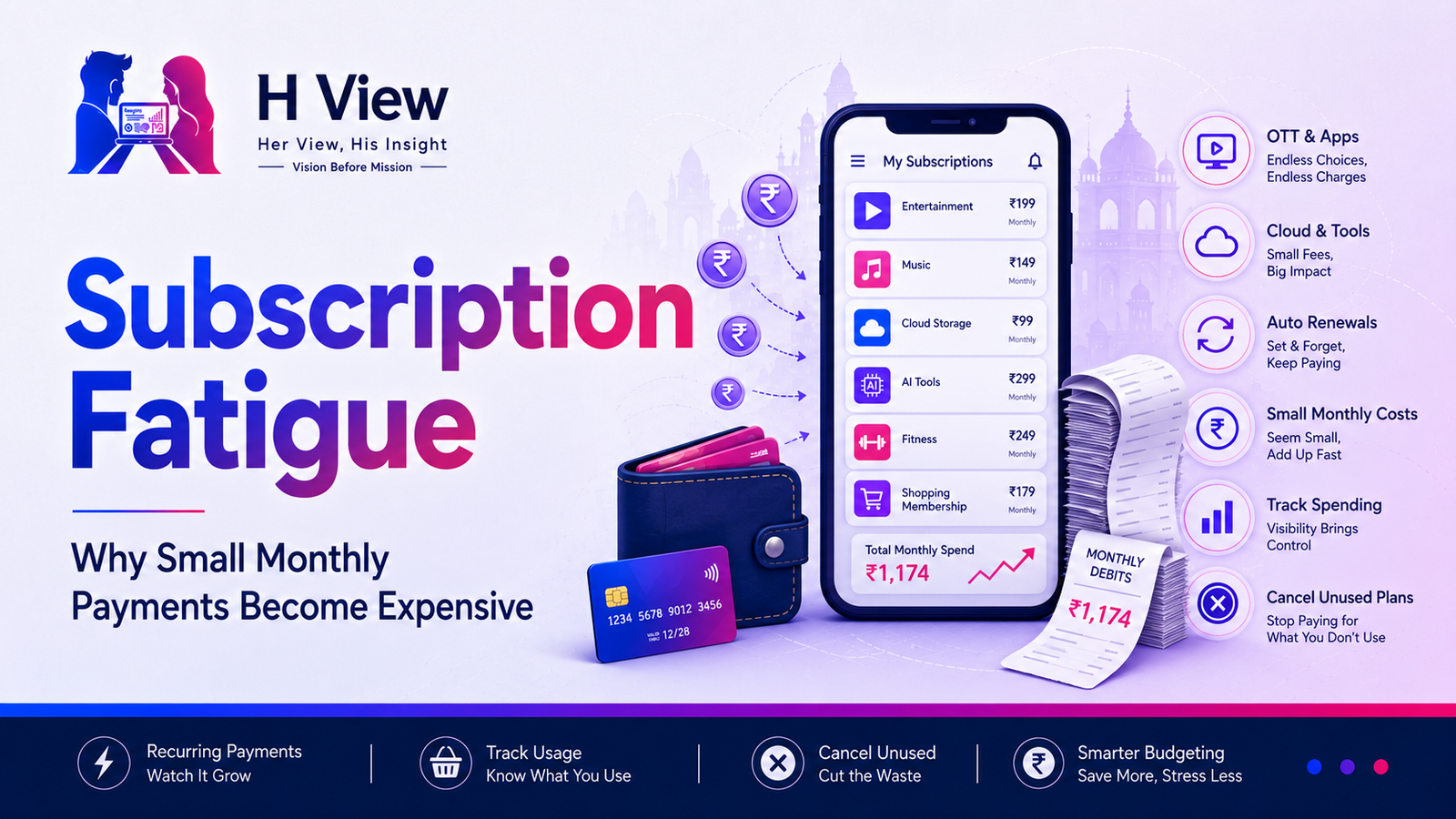
Subscriptions look small when we buy them.
₹99 per month.
₹149 per month.
₹199 per month.
₹499 per month.
At that moment, the amount does not feel serious. We tell ourselves, “It is just a small payment.” But after a few months, we may realise that these small payments are silently becoming a big monthly expense.
OTT platforms, music apps, cloud storage, editing tools, AI tools, premium apps, fitness apps, learning platforms, food memberships, shopping memberships and productivity tools all follow the same pattern.
One subscription feels manageable. Ten subscriptions feel invisible until the bank statement arrives.
At H View, our practical view is simple:
A subscription is useful only when you use it regularly. If you are paying and forgetting, it is no longer convenience. It is leakage.
What Is Subscription Fatigue?
Subscription fatigue is the feeling of being tired, confused or financially burdened by too many recurring payments.
It happens when people subscribe to many services but do not use all of them properly.
Earlier, many purchases were one-time. You bought a product and used it. Today, many services are monthly or yearly. This makes access easier, but it also makes spending continuous.
The problem is not that subscriptions are bad. Many subscriptions are genuinely useful.
The problem begins when we lose track.
Why Subscriptions Feel Affordable at First
Subscriptions are designed to feel light.
A monthly payment looks easier than a large one-time payment. That is why many users say yes quickly.
For example, paying ₹2,400 once may feel expensive. But paying ₹199 per month feels easy, even though it becomes almost the same over a year.
This is the psychology behind subscriptions.
The amount feels small.
The payment is automatic.
The renewal happens quietly.
The user forgets.
The company earns continuously.
That is why we need to check subscriptions like we check shopping expenses.
Common Subscriptions People Forget
Most people remember the big ones. But the small ones are the real issue.
Common forgotten subscriptions include:
- OTT platforms
- Music streaming apps
- Cloud storage
- Mobile app premium plans
- AI tools
- Design tools
- Editing apps
- VPN services
- Fitness apps
- Food delivery memberships
- Shopping memberships
- Online courses
- News apps
- Gaming subscriptions
- Dating apps
- Productivity tools
Sometimes we subscribe for one urgent need and then forget to cancel.
A student may subscribe to a learning app for one exam.
A creator may subscribe to an editing tool for one video.
A family may subscribe to an OTT app for one show.
A business owner may subscribe to a tool for one project.
But the auto-renewal continues.
The “Free Trial” Trap
Free trials are useful, but they can also become expensive.
Many services offer a free trial for 7 days, 14 days or 30 days. The user signs up happily, enters payment details and plans to cancel later if not needed.
But life gets busy.
The trial ends.
The card gets charged.
The user notices later.
Sometimes the refund is not easy.
A free trial is not really free if you forget the cancellation date.
Before starting a trial, ask yourself:
Will I use this immediately?
Do I really need this service?
Have I set a reminder before renewal?
Is cancellation simple?
Is the plan monthly or yearly after trial?
If you are not sure, do not enter payment details casually.
Monthly vs Yearly Plans
Yearly plans often look attractive because they offer discounts.
But yearly plans are useful only when you are sure you will use the service for the full year.
Many people buy annual plans because the app says “Save 40%.” But saving money on something you do not use is not saving.
Monthly plans give flexibility.
Yearly plans give discounts.
Choose yearly only for services you already use regularly.
For new tools, monthly is safer.
How Subscriptions Quietly Affect Your Budget
The danger of subscriptions is that they do not feel like spending every time.
When you buy something from a store, you make an active decision. But subscriptions renew automatically.
This makes them easy to ignore.
Let’s say you have:
₹149 music app
₹199 OTT app
₹299 cloud storage
₹499 AI tool
₹199 editing app
₹99 shopping membership
₹299 learning app
₹599 software tool
Individually, they look small. Together, they become a serious monthly amount.
Over one year, this can become thousands of rupees.
The real question is not “Can I afford this monthly?”
The better question is “Is this subscription giving value every month?”
Signs You Have Subscription Fatigue
You may have subscription fatigue if:
- You do not remember all active subscriptions
- You pay for apps you rarely open
- You have multiple OTT apps but watch only one
- You subscribed for one use and forgot to cancel
- You feel surprised by monthly deductions
- You are paying for duplicate tools
- You have yearly plans you no longer use
- You keep apps because “maybe I will use them later”
- You are not sure which card is being charged
- You avoid checking your bank statement
If any of these feel familiar, it is time for a subscription cleanup.
Which Subscriptions Are Worth Keeping?
Not every subscription should be cancelled.
Some subscriptions genuinely improve life or work.
A subscription is worth keeping if it:
- Saves time
- Helps you earn money
- Supports learning
- Improves health
- Is used every week
- Replaces a bigger expense
- Supports your work
- Gives clear entertainment value
- Helps your family regularly
- Offers better value than alternatives
For example, a cloud storage plan may be worth it if it protects your important files. An AI tool may be worth it if it saves hours of work. A fitness app may be worth it if you actually follow the routine.
The keyword is usage.
Which Subscriptions Should You Cancel?
Cancel subscriptions that are:
- Rarely used
- Duplicated by another app
- Bought only for one task
- Renewing without awareness
- Too expensive for the value
- Easy to replace with free alternatives
- Kept only because of guilt
- Not used by anyone in the family
- No longer matching your lifestyle
Do not keep paying for future imagination.
If you have not used a subscription for two months, you probably do not need it right now.
The Family Sharing Problem
Many families subscribe to multiple platforms because different people want different content.
One person wants movies.
One person wants sports.
One person wants kids content.
One person wants music.
One person wants cloud storage.
This can become expensive.
Instead of keeping everything active all the time, families can rotate subscriptions.
For example:
One OTT platform this month.
Another next month.
Pause the unused one.
This simple habit can reduce unnecessary spending without removing entertainment completely.
How to Do a Subscription Audit
A subscription audit means checking all recurring payments and deciding what to keep.
Do this once every month or once every three months.
Step 1: Check bank statements and UPI/card history.
Step 2: List all active subscriptions.
Step 3: Write the monthly or yearly cost.
Step 4: Mark how often you use each one.
Step 5: Cancel unused or duplicate services.
Step 6: Set reminders for trial and renewal dates.
Step 7: Keep only the services that give real value.
A simple table helps:
Subscription
Cost
Renewal date
Usage
Keep or cancel
This small exercise can save a lot of money.
Smart Subscription Rules
Use these practical rules before subscribing.
Do not subscribe on impulse.
Start with monthly before yearly.
Cancel free trials before the renewal date if unsure.
Do not keep duplicate services.
Share family plans only when genuinely useful.
Review all subscriptions every month.
Avoid paying for “maybe later” usage.
Set a fixed subscription budget.
The goal is not to stop using digital services. The goal is to pay only for what you actually use.
Her View
From the user experience side, subscriptions are convenient. They remove repeated payments and give quick access to entertainment, tools, learning and productivity.
But the same convenience can become stressful when too many payments happen silently.
A clean subscription list feels peaceful. You know what you are paying for, why you are paying, and whether it is useful.
The best experience is not having everything. The best experience is having what you actually use.
His Insight
From the money side, subscriptions are a long-term commitment disguised as a small monthly cost.
Businesses love subscriptions because they create predictable revenue. Users should understand this clearly.
A small monthly fee becomes powerful when repeated across millions of users. That same logic affects your personal budget too.
The smart approach is to treat every subscription like a mini loan against your future income. If it does not provide regular value, cancel it.
H View Recommendation
Subscription fatigue is not about avoiding all paid services.
It is about being intentional.
Keep subscriptions that save time, improve work, support learning, entertain your family or genuinely add value.
Cancel subscriptions that are unused, duplicated, forgotten or emotionally kept.
At H View, our recommendation is simple:
Pay for value, not for access you barely use.
FAQs
Subscription fatigue is the stress or financial burden caused by having too many recurring monthly or yearly payments for apps, OTT platforms, tools, memberships and digital services.
Subscriptions feel small individually, but multiple monthly payments add up over time. Auto-renewal also makes users forget how much they are spending.
List all active subscriptions, cancel unused services, avoid duplicate apps, rotate OTT platforms, use monthly plans first and set reminders for free trials.
Yearly subscriptions are better only if you are sure you will use the service regularly for the full year. For new tools, monthly plans are safer.
Review subscriptions at least once every three months. If your budget is tight, review them every month.
Final View
Subscriptions are useful when they make life easier. They become a problem when they continue without attention.
A small monthly payment may not hurt today, but many small payments together can quietly reduce your savings.
At H View, our final view is simple:
Subscriptions should support your life, not silently control your budget.