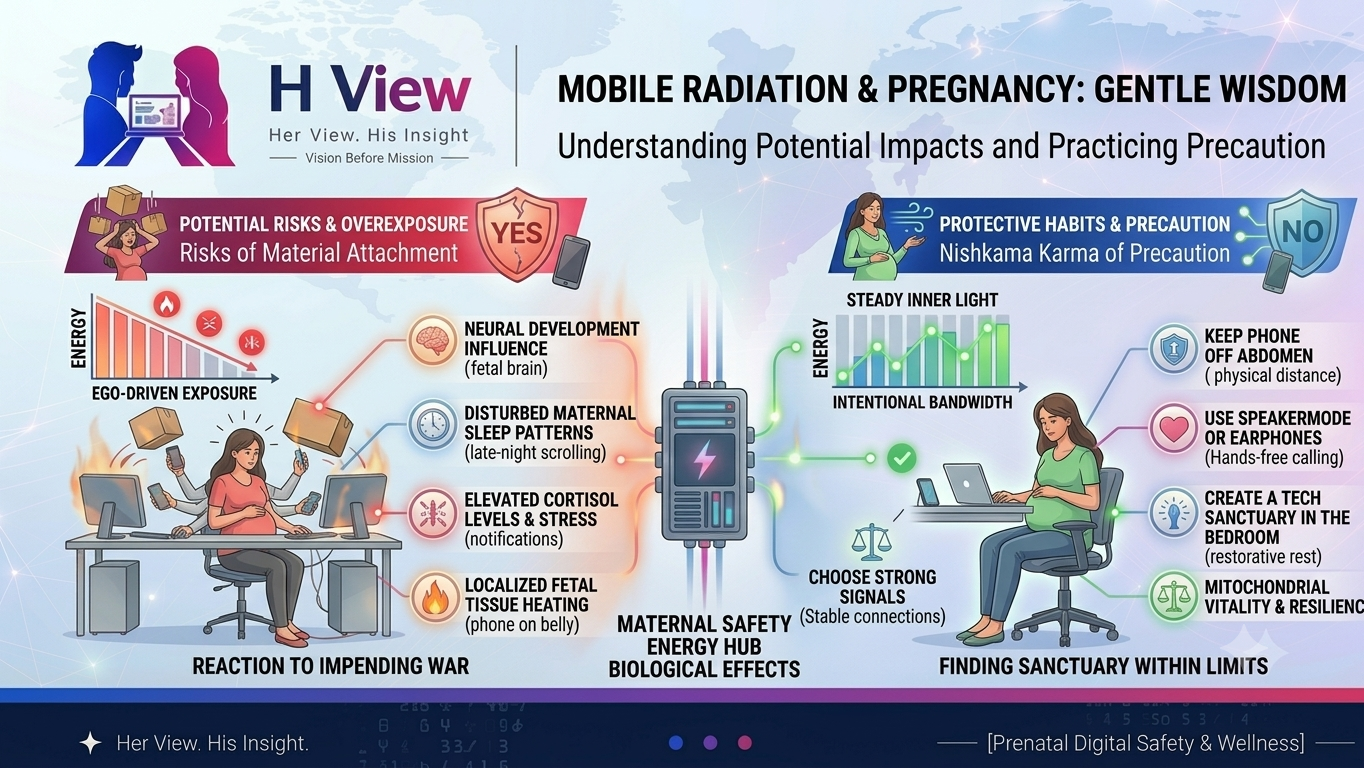
Pregnancy can make ordinary questions feel urgent, especially when a phone is part of daily life. Many expectant parents wonder whether calls, messages, Wi-Fi or carrying a phone near the abdomen could affect a baby. The most responsible answer is reassuring but qualified: research has not established that everyday mobile-phone radiofrequency exposure causes pregnancy harm, while the evidence specific to pregnancy still has limitations.
This distinction matters because “no established harm” is not the same as proving that every possible exposure has been studied perfectly. It also means readers should not be frightened by claims that a phone can disrupt fetal brain development, raise a mother’s cortisol, or heat a baby through clothing when those claims are not supported by reliable human evidence. This guide separates what is known from what remains uncertain and offers proportionate choices without presenting them as medical requirements.
The short answer
Mobile phones use radiofrequency electromagnetic energy to communicate with networks. This is non-ionizing energy, which differs from ionizing radiation such as X-rays; the word “radiation” covers both, but their physical effects are not interchangeable. Current public-health sources have not established that ordinary cell-phone RF exposure causes pregnancy complications, and the 2024 human evidence review found that the available studies are uncertain rather than conclusive proof of either harm or zero risk.
What the pregnancy research can and cannot tell us
A 2024 systematic review of human observational studies examined radiofrequency exposure and outcomes including preterm birth, low birth weight, miscarriage, stillbirth and small-for-gestational-age birth. For general-population studies, the review did not find a clear association between reported mobile-phone exposure and preterm birth or low birth weight. Some analyses reported a small association with small-for-gestational-age birth, but the authors rated the overall evidence as low or very low certainty because of limitations such as bias, inconsistent results, indirect exposure measures and imprecision.
Most observational studies cannot prove that a phone caused an outcome. Researchers may estimate exposure from a person’s reported phone use or distance from a transmitter, which is not the same as measuring the RF energy absorbed by a particular person over time. Other factors can also affect pregnancy outcomes, and a statistical association may reflect those factors or measurement limits rather than a direct effect.
The World Health Organization describes tissue heating as the main established biological effect of radiofrequency fields and says that health effects from low-level, long-term exposure have not been confirmed, while research continues. Its pregnancy discussion covers a range of environmental and occupational electromagnetic-field sources, not only smartphones, so it should not be misread as a phone-specific guarantee. The U.S. Food and Drug Administration likewise says its review of scientific evidence has not linked cell-phone RF radiation with health problems and that it continues to monitor the research.
These sources do not justify claiming that a developing fetus is uniquely “more sensitive” to ordinary phone signals or that phones have been shown to alter fetal neural pathways. They also do not justify telling pregnant people that they must put their phones away, use airplane mode overnight, or change how they contact a clinician. The evidence is best described as reassuring overall, with important limits in pregnancy-specific research.
Radiofrequency is different from sleep, screen time and device heat
Several different concerns are often blended together under the label “mobile radiation.” RF exposure is one question; screen brightness, late-night notifications, posture and ordinary device warmth are separate questions with different evidence. For example, choosing Do Not Disturb because notifications interrupt rest may be useful for comfort, but it should not be presented as a proven way to protect a pregnancy from RF energy.
A phone resting against the body can make a person more aware of its warmth, but that does not establish that it is heating fetal tissue or creating a pregnancy danger. Do not infer a hidden medical hazard from the fact that a device becomes warm during charging or heavy use. Follow the phone maker’s instructions, avoid using a damaged or overheating device, and keep it in a comfortable place for ordinary practical reasons.
Optional ways to reduce exposure without creating fear
People who would feel more comfortable reducing near-body exposure can create distance when it is convenient. Use speakerphone or a wired or wireless hands-free option for a long call, and place an actively used phone on a nearby surface instead of holding it against the abdomen. These are optional exposure-reduction choices; current evidence does not establish them as pregnancy safeguards or as substitutes for prenatal care.
Keep using a phone when it helps you stay connected with family, work or your healthcare team. Airplane mode can be used when you personally want fewer connections or notifications, but there is no basis here for treating it as a necessary nightly pregnancy rule. If you want to understand the measurement printed in some phone specifications, our guide to SAR values and phone exposure explains what that number can and cannot tell you about real-world use.
Be cautious with products marketed as “radiation shields” or with posts that promise a way to make a phone completely safe. A marketing claim is not a clinical recommendation, and a product should not be purchased on the strength of frightening pregnancy language alone. For the wider standards behind how H View handles evidence and corrections, see our Editorial Policy; our Health archive gathers the site’s health explainers in one place.
Her View: reassurance should not become pressure
Pregnancy advice can quietly turn everyday decisions into tests of whether someone is being careful enough. A phone is also a connection to appointments, support and urgent help, so asking people to disconnect can create more worry than it resolves. A fair response gives expectant parents accurate context and leaves room for personal comfort instead of assigning blame.
His Insight: describe uncertainty precisely
Evidence communication should distinguish measured findings from a proposed explanation. A small association in observational research is a reason to study a question carefully, not proof that a phone caused harm; a lack of a confirmed link is not a guarantee that every future study will be identical. Good health writing makes those limits visible rather than using them to sell fear or false certainty.
H View Verdict
Available public-health guidance and human pregnancy studies do not establish that everyday mobile-phone RF exposure causes pregnancy harm. The pregnancy-specific evidence has limitations, so absolute claims at either extreme are not justified. Use your phone normally, choose extra distance or hands-free calling if it makes you comfortable, and ask your obstetrician or midwife about personal medical concerns rather than relying on alarming online claims.
Frequently asked questions
Can using a mobile phone harm my baby during pregnancy?
Current research has not established that ordinary mobile-phone RF exposure causes pregnancy harm. The pregnancy-specific evidence is limited and uncertain for some outcomes, so it is more accurate to say that no causal harm has been confirmed than to promise absolute zero risk. If a particular health concern applies to you, discuss it with your maternity-care professional.
Should I keep my phone away from my abdomen?
There is no established pregnancy rule requiring a phone to be kept a particular distance from the abdomen. You may place it on a nearby surface or use speakerphone if that feels more comfortable, but those choices should not be described as medically necessary protection. Keep the device where it is practical and safe for your daily needs.
Should I switch my phone to airplane mode at night?
Not as a proven pregnancy precaution. You may choose airplane mode or Do Not Disturb to reduce interruptions, but that is a personal sleep or notification preference rather than a requirement supported by pregnancy-specific RF evidence. Keep emergency contact needs in mind when choosing your settings.
Does non-ionizing mean there is no possible effect?
No single label answers every health question. Non-ionizing RF does not have the same energy as X-rays, and tissue heating is the main established interaction at sufficiently high exposure levels; researchers continue to study possible long-term effects. For pregnancy and ordinary phone use, current human evidence has not confirmed a causal harm.
Where can I read the research behind this article?
Start with the 2024 systematic review of human studies on RF exposure and adverse pregnancy outcomes, the World Health Organization’s electromagnetic-fields Q&A, and the U.S. FDA’s cell-phone evidence overview. Read the study limitations as well as the summary findings, because uncertainty is part of the current evidence. This article is educational information and does not diagnose, treat or replace individualized prenatal advice.